
How to style concrete pots: ideas that work in South African gardens
The short answer
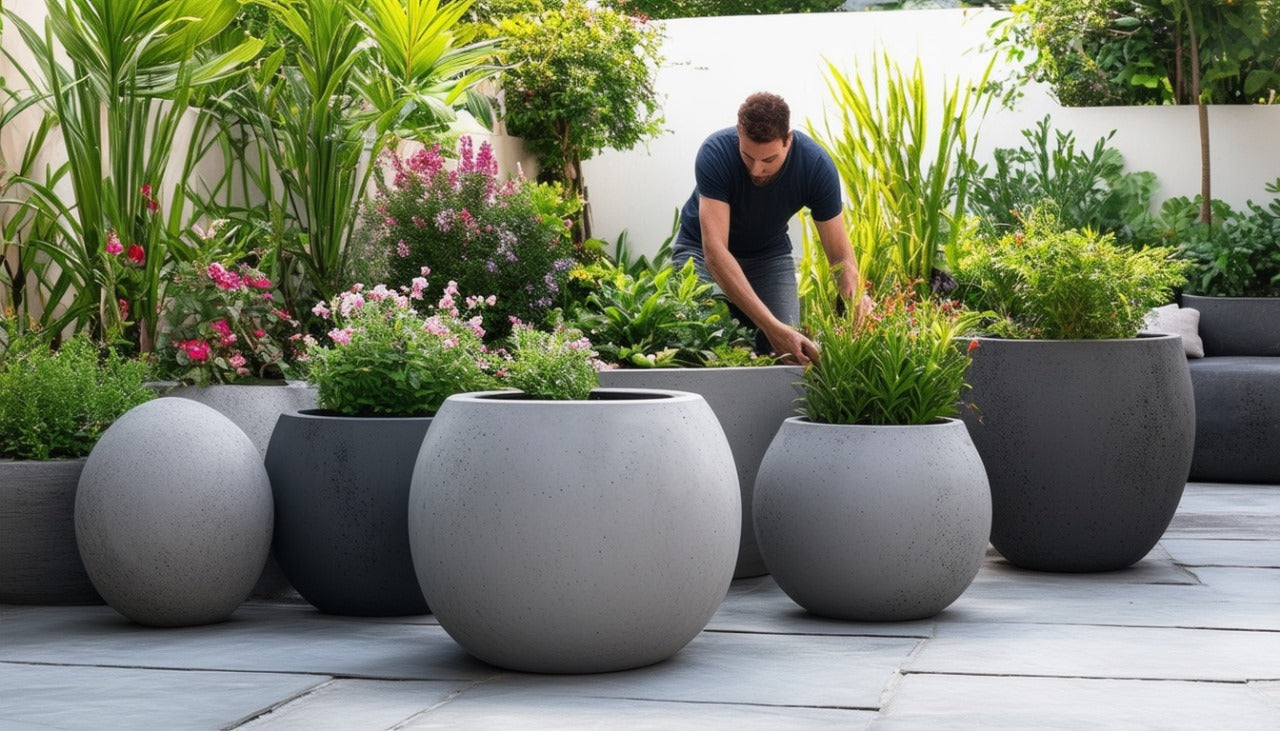
Concrete pots look best in South African gardens when you follow a few simple habits. Group them in threes of different heights rather than in pairs or rows. Pick one finish, whether raw grey, off-white or charcoal, and repeat it across the garden so the eye reads the pots as one idea. In full Highveld or Karoo sun, pale finishes stay cooler for roots and do not show dust and water marks the way dark pots do. Put one oversized pot at the front door or the end of a path and let it stand alone. Use long troughs planted with something tough like Dietes or clipped Searsia as a living screen for a braai area or a neighbour's wall. Match the plant's sun needs to the spot before you think about the pot's shape.
We see a lot of gardens. Customers send photos, we deliver into driveways across Gauteng, and we spend our own weekends fiddling with the pots outside the nursery. After enough of that you notice the same thing over and over: the gardens that look pulled together are never the ones with the most pots. They are the ones where someone made three or four quiet decisions and stuck to them.
None of what follows is a trend. Trends are what sell a magazine in July and look dated by the following July. This is what actually works in our light, which is harsher than anything a European garden book was written for, and in our weather, which goes from frost to hail to 34 degrees inside a fortnight. If you want a reference for how pot shape and colour interact, our guide on balancing pot colours and shapes is the longer read. This one is about placing them.
Group in threes, not pairs and not rows
A single pot on its own is a statement, and we will get to that. Two identical pots are a gateway, and they only work either side of something, a door or a set of steps. Anything more casual than that wants odd numbers, and three is the number that almost always works. Take one tall, one medium and one low pot in the same finish, push them close enough that they overlap slightly when you look from the main viewpoint, and plant them so the foliage reads as one shape. A tall Egg with a Strelitzia, a mid Cube with a clipped Buxus or Searsia, and a low bowl of succulents spilling over the rim is a combination we have set up in a dozen gardens and it has never looked wrong.
The trick is to vary height a lot and diameter a little. If all three pots are the same height you get a bar chart. If they are wildly different diameters the group looks like leftovers. Illinois Extension's notes on colour in container gardens make a point worth carrying over to shape too: choosing one theme and holding to it is what gives a collection its "pulled together" look. A group of three in one finish does that instantly.
Pick one finish and repeat it everywhere
The most common mistake we see is a garden where every pot was bought on a separate Saturday. A terracotta urn here, a glazed blue thing there, a black plastic pot somebody meant to replace. Each is fine. Together they argue. Decide on one finish for the whole garden, raw concrete grey, off-white, or charcoal, and buy into it every time. It sounds restrictive and it is the opposite, because once the pots agree you can plant anything you like and it will look intentional.
Concrete makes this easy, since a raw grey pot next to a raw grey trough already matches, and over a couple of seasons they weather together. If you need a smaller version of the same look for a table or a windowsill, our Lightweight Décor range repeats the finishes of the big pots at a scale you can pick up with one hand, so the theme carries indoors and onto a balcony without breaking.
Pale finishes earn their keep in full sun
Dark pots are handsome and they photograph beautifully in shade. In a north-facing Highveld courtyard in January they are a problem. A charcoal pot in full sun absorbs heat all afternoon and passes it straight into the root zone, and it shows every splash mark, every dust film and every calcium ring from borehole water. Pale concrete, off-white or natural grey, stays cooler to the touch, hides dust, and makes green foliage look greener, which is what you actually want people to look at.
So the rule we use is simple: pale in the sun, dark in the shade. A charcoal pot under a tree or against a shaded wall is gorgeous, and the shade also keeps the finish clean. In the open, in Pretoria or Bloemfontein or anywhere in the Karoo, go pale. Our Fibre Concrete Mix is cast to sit in that sun for years without spalling or fading, so the finish you choose is the finish you keep.
One statement pot at the entrance
Every home has one spot where a single large pot does more than ten small ones could, and it is nearly always the front door or the end of the main path. Choose a pot that feels slightly too big when you first place it. Something like our Nevada in one of its taller sizes, or a big Egg, planted with one bold plant and nothing else. A Strelitzia reginae is our default, and SANBI's PlantZAfrica page on Strelitzia reginae calls it an ideal pot plant for good reason: evergreen, architectural, happy in full sun and flowering for months. A clipped olive or a big aloe works the same way.
Resist the urge to flank it with anything. A statement pot needs space around it to read as a statement, and it needs to sit dead centre on the axis you approach along. We wrote a whole piece on why a statement planter changes how a home feels from the street, and the short version is that one confident pot says more than a collection ever will.
Troughs as living screens
The other place concrete pots do real work is as a screen. A long trough planted densely gives you a hedge in a season, on a paved area where nothing else could grow, and it can be positioned exactly where the neighbour's window or the braai smoke is. Two or three troughs end to end along the edge of a patio make a low wall of green that softens the boundary without a builder.
Choose plants that take being crowded, take sun, and shrug off frost. Dietes grandiflora is the workhorse here. The SANBI page on Dietes grandiflora describes it as frost and drought hardy and happy in sun or shade, and it flowers through spring and summer in a trough on almost no attention. Clipped Searsia crenata, Carissa, or a row of Portulacaria afra do the same job with a tighter, more formal outline. Fill the base of a deep trough with Pot Filler, top up with Bark Outdoor Potting Soil, and set it on concrete pot feet so water can escape onto the paving. Our trough range runs from balcony length to over a metre.
Dress the soil, not just the plant
A pot with bare soil showing looks unfinished no matter how good the plant is. A layer of White Pebbles over the surface tidies the whole thing up, keeps the top of the soil cooler in summer, slows evaporation, and stops the summer thunderstorms from splashing soil up the side of a pale pot. On a dark pot use a pale stone, on a pale pot use a darker gravel or bark, so there is a little contrast at the rim. It is a five minute job and it is the difference between a pot that looks planted and a pot that looks designed.
Match the plant to the sun before anything else
All of this styling advice fails if the plant in the pot is dying. Before you fall for a shape, stand in the spot and count the hours of direct sun it gets, then choose the plant for that, and only then the pot. A fern in a beautiful pot in the full sun of a west-facing wall will be brown by Christmas. If you would rather skip the guesswork, our pre-planted sun and shade pots come already matched, and the gallery shows how customers have grouped and placed them in real gardens around the country.
Three pots in one finish, pale where the sun hits, a single oversized pot at the door, a trough or two doing the work of a hedge. That is most of it. The pieces we cast specifically to hold a space on their own, the tall Nevadas, the big Eggs and the wide bowls, are gathered in one place, and you can choose your statement pot from the feature range here.
Choose the one pot that holds the space
Pick a tall Nevada, a big Egg or a wide bowl from the feature pot range and let it stand alone at your entrance.
Shop feature pots →Frequently asked questions
How many pots should I group together?
Three is the number that almost always works: one tall, one medium and one low, in the same finish, placed close enough to overlap from the main viewpoint. Pairs suit doorways and steps; rows suit paths.
Are dark or light concrete pots better in full sun?
Pale finishes are better in full sun. They stay cooler for the roots, hide dust and water marks, and make foliage look greener. Keep charcoal and dark pots for shaded spots where they stay clean.
What plant works in a statement pot at the front door?
Strelitzia reginae is the classic choice: evergreen, architectural and happy in full sun. A clipped olive, a large aloe or a Searsia standard work in the same way. Plant one bold plant and nothing else.
Can concrete troughs be used as a privacy screen?
Yes. Long troughs planted densely with Dietes grandiflora, clipped Searsia crenata, Carissa or Portulacaria afra make a hedge on paving within a season, and can be placed exactly where you need the screening.
Should all my garden pots match?
They should share one finish, such as raw grey, off-white or charcoal, so they read as one idea. Shapes and sizes can vary freely once the finish is consistent.

Leave a comment
This site is protected by hCaptcha and the hCaptcha Privacy Policy and Terms of Service apply.