
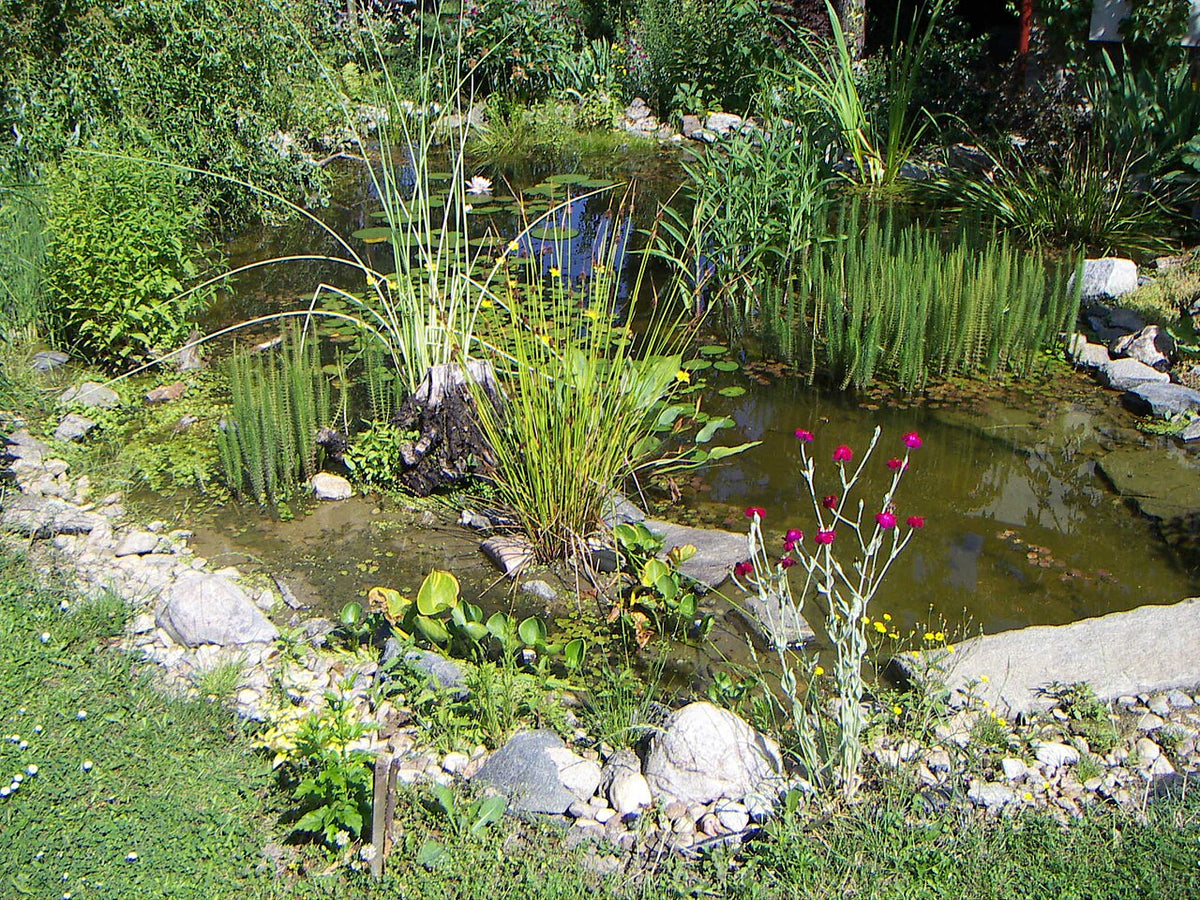
Fibreglass or concrete pond? A buying guide for South African gardens
The short answer
A preformed fibreglass pond is the quickest route to real standing water. It is light enough to move into place yourself and drops into a dug hole or onto a firm, level base. A concrete basin is heavier and more permanent, and stands on a patio with no digging. Before you choose, think about depth. The RHS recommends at least 38 cm for any pond so the water does not overheat, and ideally 75 cm if you want fish. Our fibreglass ponds are shallow, 200 mm and 280 mm deep, which makes them lovely reflecting pools, planted ponds and bases for a water feature, but not homes for fish in a South African summer. Put the pond where at least half of it gets full sun, on level ground clear of big tree roots, and within reach of a weatherproof outdoor socket.
Most people who ask us about ponds have already pictured it. A still sheet of water at the bottom of the garden, a few lilies, the sky reflected in it on a hot afternoon, and somewhere nearby the sound of a trickle. The picture is the easy part. The questions that decide whether you end up loving it are more practical ones: how deep, how big, where it goes, and what happens with power and mosquitoes. This guide works through them in roughly the order they come up.
We sell two kinds of pond, preformed fibreglass shells and cast concrete basins, along with the pumps and water features that go with them, so this is written for someone choosing between those. If you are planning a large lined pond dug by a landscaper, a lot of the same thinking applies, but the build itself is a different job.
Fibreglass or concrete, and the real difference between them
A preformed fibreglass pond is a moulded shell. It is light for its size, which is the whole point, because you can carry and position a two metre pond without a crane or a team of helpers. It holds water reliably, it will not tear or perish the way a cheap liner can, and it gives you a finished edge and a fixed shape. The trade off is that the shape is decided for you, and so is the depth.
A concrete basin is the opposite. It is heavy, which makes it permanent and stable, and it looks as though it belongs next to concrete pots and paving because it is the same material. Our Lilly Pond is a good example, a wide, shallow bowl in three sizes, from 720 mm across up to 1240 mm across and 400 mm deep. It sits on a patio or in a bed without any digging, and it pairs well with a water feature or a few floating plants. The Square Pond does the same job in a formal square, 910 mm on each side and 220 mm deep.
So the honest way to choose is by what you want the water to do. If you want a pond that reads as part of the landscape, sunk into a bed with plants growing right up to the edge, fibreglass makes that straightforward. If you want water as an object, a basin on a terrace that you can see from the lounge, concrete is the better fit.
The ponds we carry, and what each is good for
The Rock Pond brings more people to our site from Google than any other product we sell, and it is easy to see why. It is a fibreglass shell with a mottled stone finish, 2000 mm by 1800 mm and 200 mm deep, with an irregular, natural outline that settles into a rockery or a planted bed as though it had always been there.
The Rectangular Pond is 2500 mm long, 910 mm wide and 280 mm deep. It suits a formal garden, a courtyard, or a long reflecting pool running beside a path, and it comes in six finishes from Flinted White to Granite and Velvet. On the concrete side there are the Lilly Pond and the Square Pond, both of which work as self contained water on a hard surface. Several of our water features are made to stand in or beside water, and the Boulder, a cast rock that water wells up through and runs over, looks particularly at home next to a Rock Pond.
Depth is the number that matters most
This is where most pond plans go wrong, so it is worth slowing down. The Royal Horticultural Society's guide to making a new pond says every pond should be at least 38 cm deep, because shallower water overheats in summer, which leads to algae and a drop in oxygen, and it is also more likely to freeze in winter. For the widest range of plants, and for fish, it suggests at least 75 cm.
That advice is written for British summers. In a South African January, a shallow pond on a sunny patio can get properly warm by mid afternoon. So we would rather be straight with you about our own range. The Rock Pond at 200 mm and the Rectangular Pond at 280 mm are shallow shells. They make beautiful reflecting pools, they suit water plants, and they are an ideal base for a water feature that keeps the water moving. Add a flat stone or two at the edge and birds will come down to drink. They are not fish ponds. The deepest thing we sell is the large Lilly Pond at 400 mm, which does clear the RHS minimum, but it is still a basin rather than a home for fish.
If fish are the whole point, the RHS also recommends a surface area of at least 3.5 square metres and notes that heavily stocked ponds usually need a filter. Koi in particular grow large and need far deeper, filtered water than any preformed shell can offer, so if koi are the dream, talk to a koi specialist before you buy anything.
Where to put it
The same RHS guide says a pond should sit in sun or partial shade, with some shade over part of the water to help with algae but at least half of it in full sun, on level ground with no big tree roots in the way. That last point is worth taking literally. Roots will lift or stress a shell over time, and a tree overhead drops leaves and flowers into the water all year, where they rot and feed the very algae you are trying to avoid. A jacaranda is a glorious thing in October. It is less glorious sitting in your pond.
Then think about where you will see it from. A pond you can only see from the far end of the lawn gets visited twice a year. One you can see from the kitchen window or the stoep gets looked at every single day, and that is really what you are paying for. Finally, think about power before you dig, because a pump needs a socket, and a fibreglass shell is a lot harder to move once it has been backfilled.
Sinking a fibreglass pond, or setting it above ground
A fibreglass shell can go into the ground or sit on top of it. Sunk in, it disappears into the garden and you can plant right up to the rim. Above ground, it needs a firm and completely level base, such as a concrete slab or level paving, because the shell is designed to be supported evenly and a sheet of water shows the slightest slope straight away.
If you are sinking it, the usual method is to mark out the shape, dig a hole a little wider and deeper than the shell, and bed the bottom on a layer of soft sand so that no stones press against it. Set the shell in, check it with a spirit level in both directions, and then fill it with water slowly while you backfill around the sides with sand or sifted soil, so the pressure inside and outside rises together and the walls stay supported. Check the level again as you go. None of it is difficult, but it rewards patience, and it is a much easier job with two people.
Moving water, and choosing a pump
A still pond is lovely, but most people end up wanting a little movement, and a pump gives you that along with some practical benefits. Moving water picks up oxygen at the surface, it stops the water standing still, which is exactly what mosquitoes are looking for, and it gives you the sound that makes a pond feel alive.
The pump you need depends mainly on how high it has to lift the water, not on how big the pond is. Every pump has a maximum head, the height at which the flow drops to nothing, so choose one whose maximum head sits comfortably above the height of your feature. We carry two Hailea pumps. The HX8815 uses 20 W, moves up to 1400 litres an hour and has a maximum head of 1.8 m, with a 1.3 m cable. The HX8825 uses 35 W, moves up to 2400 litres an hour with a maximum head of 2.15 m, has a 2.8 m cable, and comes with a nozzle kit and a flow adjuster so you can tune the spray. For a low bubbler beside a pond, the smaller pump is plenty. For a taller feature, or water that has to climb a column before it falls, go for the bigger one.
A round or square pump house hides the pump and cabling while keeping them easy to reach, which matters more than it sounds, because you will want to get at the pump to clean it. Both pumps carry a one year warranty that is handled through PoolSpa rather than through us, and the details are on our pump warranty page. We go into pumps, cables and running a feature day to day in how to set up a water feature.
Power, safety and running costs
Water and electricity need respect. If you do not already have a socket outside, have one installed properly. Kandua, the South African home services platform, puts it plainly in its guide to installing new electrical outlets: outdoor sockets need to be weatherproof and connected to an earth leakage circuit breaker in line with SANS 10142-1, the work should only be done by a qualified and registered electrician, and that electrician will issue or update your certificate of compliance. Please do not run an indoor extension lead across the lawn to a pond. It is the one shortcut that is genuinely not worth taking.
Running costs are smaller than most people expect. A 20 W pump running around the clock uses 0.48 kWh a day, which is about 14.4 kWh over a 30 day month. The 35 W pump uses 0.84 kWh a day, about 25 kWh a month. Multiply that by your own municipal or Eskom tariff and you have your answer, and a plug timer brings it down further if you only want the sound when you are home.
Mosquitoes, algae and upkeep
Mosquitoes lay their eggs on still water. The CDC's advice on mosquito control at home is to empty and scrub anything that holds water, bird baths and pot saucers included, once a week. You obviously cannot do that with a pond, so the practical answer is to keep the surface moving with a pump, keep it clear of leaves and debris, and hunt down the forgotten saucers and buckets nearby, which are often the real culprits.
Algae is the other common complaint, and it is mostly a sunlight and nutrient problem. Partial shade over some of the water helps, which is part of why the RHS suggests it, and so do plants that cover part of the surface. Beyond that, upkeep is modest. Top the pond up in summer, because evaporation in a hot, windy spell is real. Scoop out leaves before they sink. Clean the pump intake when you notice the flow dropping, and once or twice a year give the whole thing a proper clean.
A pond changes a garden more than almost anything else you can buy for it. It brings in birds, it softens the feel of a hot afternoon, and it gives you somewhere to sit and simply look. Get the depth and the spot right, sort out the power properly, and the rest is mostly enjoying it. If you are still weighing up a pond against a water feature, our guide to choosing a water feature covers the other side of that decision, and if you want to make the most of the birds a pond brings in, have a look at how to attract more birds into your garden.
Ready to add water to the garden?
Browse fibreglass ponds, pumps, pump houses and water features, delivered across Gauteng, Cape Town and Durban.
Shop ponds and water features →Frequently asked questions
How deep should a garden pond be?
The RHS recommends at least 38 cm for any pond, so the water does not overheat in summer or freeze easily in winter, and at least 75 cm if you want the widest range of plants or plan to keep fish.
Can I keep fish in a fibreglass pond?
Not in ours. Our fibreglass ponds are 200 mm and 280 mm deep, well under the depth the RHS recommends for fish, and shallow water gets too warm in a South African summer. They work beautifully as reflecting pools, planted ponds or the base for a water feature.
Do I need a pump for a pond?
Not for a still, planted pond, but most people add one. Moving water picks up oxygen, gives you sound, and stops the surface standing still, which is what mosquitoes look for.
Which pump should I buy for a pond or water feature?
Choose by lift height. The Hailea HX8815 lifts water up to 1.8 m and suits low bubblers and smaller features. The HX8825 lifts up to 2.15 m with more flow, a nozzle kit and a flow adjuster, and suits taller features.
Do you deliver ponds?
Yes, we deliver across Gauteng, Cape Town and Durban for R650. The fibreglass ponds are large but light, so all you need is a clear route from the gate to the spot.

Leave a comment
This site is protected by hCaptcha and the hCaptcha Privacy Policy and Terms of Service apply.