
What size pot does a tree need? A tree by tree guide
The short answer
For a tree that will live in a pot for years, the RHS puts the final container at a minimum of about 45 cm across, and 45 to 50 cm for most fruit trees. Treat that as the floor. A pot roughly a third of the tree's finished height looks right and gives the roots room, so a tree kept at about 1.8 m sits well in a pot around 60 cm tall and wide. Pot up in stages rather than moving a young tree straight into a huge pot, because a small root ball in a lot of wet compost is where root rot starts, and citrus and figs in particular dislike being overpotted. Choose a wide, heavy pot for anything tall in wind, make sure it drains, stand it on pot feet, and refresh the top few centimetres of soil every spring.
The question usually arrives with the tree already in the boot of the car. Someone has fallen for an olive at the nursery, or been given a lemon in a black bag for their birthday, and now they want to know which pot it needs. The honest answer is bigger than the nursery bag and often smaller than you would think, and the right number depends a lot on the tree.
This guide gives you the general rule first, then goes tree by tree through the ones South Africans most often grow in pots, and finishes with the practical side: what to fill the pot with, how to keep the tree watered and fed, and how to stop a tall tree in a heavy pot becoming a problem when the wind picks up.
The rule of thumb, and where it comes from
The Royal Horticultural Society's advice on growing trees in containers is to finish with a container of at least about 45 cm, and its guide to fruit in containers suggests pots 45 to 50 cm across for most fruit. Take that as the minimum for a tree that is going to stay in its pot for the long haul.
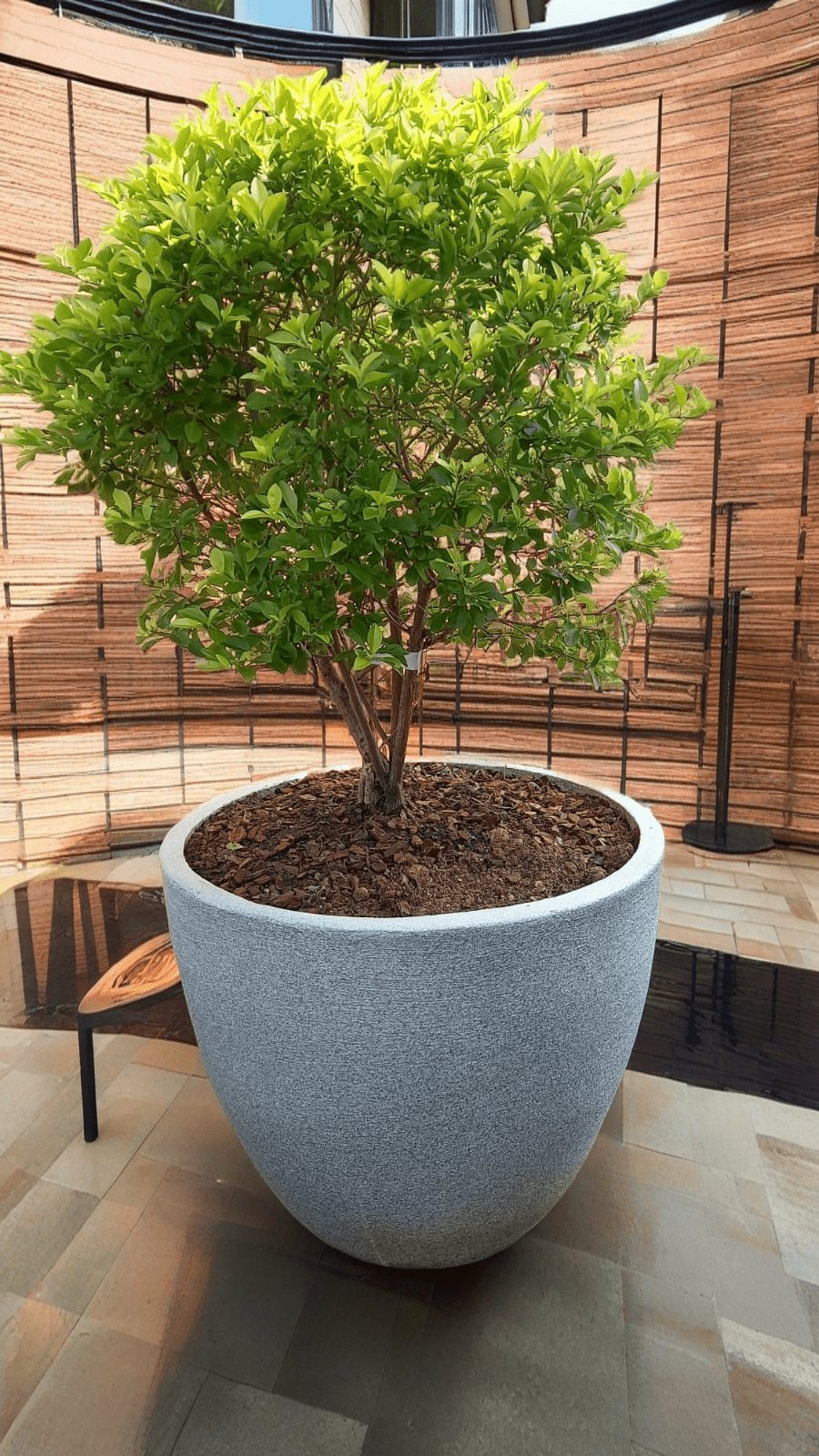
The rule we use alongside it is proportion. A pot roughly a third of the tree's finished height looks right and gives the roots enough room, so a tree you plan to keep at around 1.8 m sits well in something about 60 cm tall and wide. Go much narrower and the tree looks as though it is balancing on the pot. Go much bigger and you are paying for, filling and lifting soil the roots will not reach for years.
Width matters more than people expect. A wide pot holds more soil near the surface, where a tree does most of its drinking, and it gives a tall tree a broader and more stable base. If you are choosing between two pots of similar volume, the wider, lower one is usually the better home for a tree.
Why not just buy the biggest pot?
It is tempting to skip a step and plant a young tree straight into its forever pot. The RHS specifically advises against it, saying not to put a small tree in a very large container and to pot it up in stages instead. The reason is water. A small root ball sitting in a huge volume of compost cannot use all the water that soil holds, so the compost around it stays wet for long stretches, and wet compost with no roots in it is exactly where root rot begins.
Citrus are the most sensitive to this. The RHS guide to growing citrus says the container should be only slightly larger than the root ball, and that overpotting into a much bigger pot can cause problems. So a lemon from the nursery goes into something a size or two up, and then into its big pot a year or two later, once it has filled the first one with roots.
Tree by tree
Olive
Olives are the most forgiving tree you can put in a pot. They love sun, they cope with dry spells, and the RHS lists them among the best trees for containers, which is why you see them standing in pots at restaurant entrances all over the country. A young olive starts happily in a pot around 45 cm across and moves up to something 60 to 80 cm wide as it grows. A generous, rounded pot like the Jumbo Premium Egg suits a bushy olive, while a tall tapered pot suits one trained as a standard with a clear trunk.
Wild olive
If you want an indigenous alternative with even more toughness, the wild olive, Olea europaea subsp. africana, deserves a look. SANBI describes it as slow growing and resistant to frost, drought and wind, and a good shade or screen plant for the home garden. That slow growth is precisely what you want in a pot, and the frost resistance makes it a far safer bet than a lemon for an exposed spot on the Highveld. Give it the same size of pot you would give a European olive.
Lemons and other citrus
Citrus are the trees most people want and the ones that ask for the most care in a pot. Pot up gradually, as above, and use a free draining mix. Keep the compost just moist in summer and err on the dry side in winter, because the RHS notes that winter overwatering is one of the commonest problems and that citrus should never be left standing in water. They are hungry trees, so feed them through the year. A lemon kept at around 1.5 m ends up comfortable in a pot about 60 cm across, such as the large Monica or Carrington. On the Highveld, plan a sheltered spot for June and July, because citrus are frost tender.
Bay
Bay is another of the RHS's recommended container trees, and it is a lovely choice for a formal entrance because it clips so neatly into a cone or a lollipop. A matched pair of clipped bays either side of a front door looks best in a matched pair of tall pots, and the Nevada, which comes in heights up to 1800 mm, is the classic choice for that look.
Fig
Figs are the exception to the bigger is better instinct. The RHS guide to growing figs warns against overpotting them, because they fruit better when their roots are restricted, and it suggests starting a young fig in a pot around 30 cm wide and deep. Move it up gradually to something 45 to 50 cm across and resist the urge to go further. A fig is deciduous too, so in a pot on a north facing stoep it gives you shade in summer and lets the winter sun through.
Strelitzia, which is not a tree but gets treated like one
Strictly speaking, Strelitzia reginae is not a tree, but it is the plant people most often put in a big pot as a statement, so it earns a place here. SANBI calls it an ideal pot plant, and it grows naturally along the eastern coast from Humansdorp to northern KwaZulu-Natal. A mature clump fills out sideways more than up, so give it a wide pot, 60 cm or more across. The Pongola, which sits low and wide at 890 mm across, is made for exactly that kind of spreading planting.
Which of our pots suit a tree
For a tall tree or a standard with a clear trunk, a tall pot gives you balance and presence, and the Nevada, which comes in four heights from 850 mm up to 1800 mm, is the classic choice. For a rounder, spreading tree, choose generous proportions instead. The Pafuri, at 800 mm by 670 mm, and the Premium Colorado, at 710 mm by 590 mm, are both made with a small tree or specimen shrub in mind, and the Jumbo Premium Egg, at 610 mm by 770 mm, suits a rounded olive or lemon. For a true statement plant, the Cycad is a wide, round pot 970 mm across, with the depth and weight to show off a cycad or anything else with presence. You will find all of them in our trees and large plant pots collection, and the size chart helps you picture them in your own space before you buy.
Found the right tree?
Browse tall and wide concrete pots made for trees, from entrance pots to broad bowls, cast from our Fibre Concrete Mix.
Shop pots for trees →Filling, feeding and repotting
Trees are tall and top heavy, so stability matters as much as nutrition. The RHS suggests a loam based compost for most container trees partly because its weight helps keep them upright, and it insists on plenty of drainage holes. In practice that means a good potting mix, never soil dug from the garden, which compacts and stops draining in a pot, as we explain in can garden soil be used in pots. In a very large pot, a layer of our Pot Filler in the base saves you buying soil the roots will never reach and helps the bottom drain freely. Then stand the pot on pot feet so the drainage hole never sits in a puddle. We cover the planting steps in detail in how to plant a concrete pot so it drains well and lasts.
Trees in pots dry out far faster than trees in the ground, and the RHS is blunt that they need regular watering. Water deeply, until it runs from the base, and then let the surface dry before you water again. Each spring, scrape away the top 5 cm or so of compost and replace it with fresh, which is the RHS's recommended top dressing, and feed through the growing season. For fruit trees, the RHS suggests repotting every year or two until the tree reaches its final pot, then root pruning every other year and refreshing about 30 per cent of the compost. Our guide to watering outdoor potted plants goes further on the watering side.
Wind, weight and a tall tree in a pot
A tree in a pot is a sail on a stick. On a still day it looks wonderful, and in a summer thunderstorm or a Cape south-easter the canopy catches the wind and tries to take the pot with it. Concrete helps enormously here, because the weight that makes it a nuisance to move is exactly what keeps it standing. A wide pot helps more than a tall narrow one. If the spot is exposed, choose a lower, broader pot, keep the canopy thinned, and place the tree where a wall or the house breaks the worst of the wind. In the Cape, our notes on pots in a Cape Town garden deal with the south-easter, and our Johannesburg and Pretoria guide covers Highveld frost and summer storms.
Place the pot before you fill it. A filled tree pot is not something you move on a whim, so decide the spot, set the pot level on its feet, and fill it where it will stay. Our guide to large garden pots has more on moving and filling big pots without hurting yourself or the pot, and if fruit is what you are after, the easiest fruit trees to grow in pots covers which ones genuinely crop in a container.
Frequently asked questions
What size pot does an olive tree need?
Start a young olive in a pot around 45 cm across and move it up to 60 to 80 cm wide as it grows. Olives are one of the easiest trees to keep in a pot for the long term.
What size pot does a lemon tree need?
At each stage, only slightly larger than its root ball, which is the RHS's advice for citrus. Pot up gradually to around 60 cm across for a lemon kept at about 1.5 m.
Can a tree live in a pot permanently?
Yes, if the pot is big enough, drains well and gets fresh compost. The RHS recommends top dressing every spring and, for fruit trees in their final pot, root pruning every other year.
Should I put stones in the bottom of a tree pot?
In a large pot, a layer of Pot Filler saves soil and helps the base drain freely, but it never replaces a drainage hole. Keep the hole clear and stand the pot on feet.
Will a tree in a concrete pot blow over?
A heavy, wide concrete pot is far more stable than a lightweight one. In an exposed spot, choose a broad pot, thin the canopy and use a wall or the house for shelter.

Leave a comment
This site is protected by hCaptcha and the hCaptcha Privacy Policy and Terms of Service apply.