
Article: How to set up a garden water feature: power, pumps, placement and upkeep
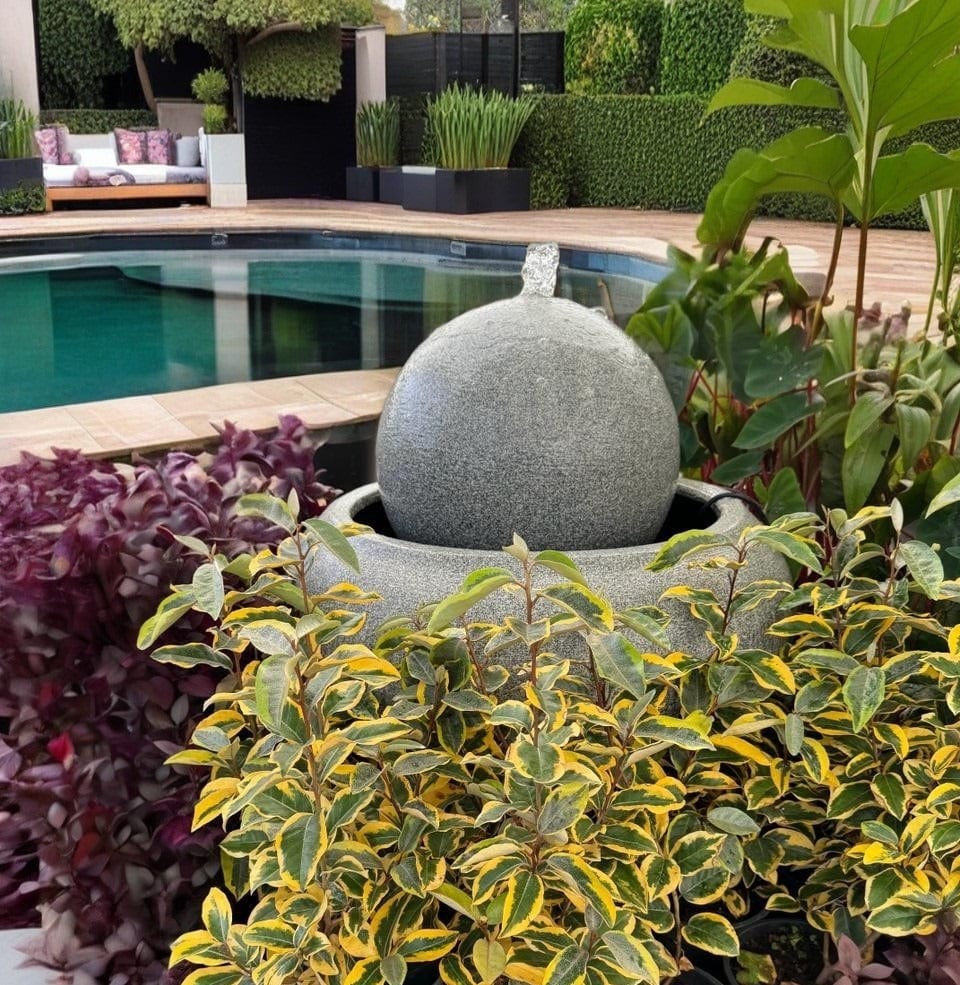
How to set up a garden water feature: power, pumps, placement and upkeep
The short answer
Most garden water features are self contained. A basin holds the water and a small submersible pump sends it back up through the feature, so there is no plumbing, just a hosepipe to fill it and a power point to run it. Set it on firm, level ground within reach of a weatherproof outdoor socket on an earth leakage circuit, installed by a registered electrician if you do not already have one. Choose a pump by how high it has to lift the water, keep it fully covered with water at all times, and top up as it evaporates. Running costs are small: a 20 W pump running all day uses about 0.48 kWh. Clean the pump intake when the flow drops, scrub off algae now and then, and the feature will look after itself for years.
The moment most people fall for a water feature is the first time they hear one on someone else's patio. The moment they hesitate is when they start wondering how it actually works. Does it need a plumber? Where does the water come from? Will it run up the electricity bill, breed mosquitoes, or need cleaning every weekend? The reassuring answer is that a modern garden water feature is about as simple as outdoor things get, and once it is set up properly it asks very little of you.
This guide takes you through it in order: how a self contained feature works, choosing the pump, where to put it, getting the power right, filling it and switching it on, running costs, and the small amount of upkeep that keeps it sounding lovely.
How a self contained water feature works
Most of the features we sell are self contained, and the rest stand in a matching basin or pond. Either way the principle is the same. The water sits in a basin, bowl or reservoir, a small pump sits in that water, and it pushes the water up through a pipe inside the feature so that it bubbles, trickles or spills back down into the basin again. The same water goes round and round. You fill it once with a hosepipe, top it up now and then as it evaporates, and that is the plumbing done.
Because the water recirculates, a feature uses far less water than people assume. The only water you lose is what evaporates or splashes out, which is why the placement advice further down matters.
Pump included, or choosing your own
Some of our features come with a pump already fitted, which is the simplest option. The Shanghai, a rounded bubbler 660 mm wide, the compact Sun at 360 mm by 360 mm, the spouted Beijing and the little tabletop Shade all arrive ready to fill and switch on. Features that come with a pump say so in their name, and if you are unsure about any other feature, ask us before you order.
For features without one, you choose the pump, and the thing that matters most is lift. Every pump has a maximum head, the height at which the flow drops to nothing, so choose one whose maximum head sits comfortably above the height the water has to climb. We carry two. The Hailea HX8815 uses 20 W, moves up to 1400 litres an hour and lifts to a maximum of 1.8 m, on a 1.3 m cable. The Hailea HX8825 uses 35 W, moves up to 2400 litres an hour and lifts to 2.15 m, on a 2.8 m cable, and comes with a nozzle kit and a flow adjuster so you can fine tune the effect. As a rough guide, low bubblers and smaller features are well served by the HX8815, and taller columns or features where water climbs before it falls want the HX8825. The full specifications are on our HX8815 and HX8825 pages.
Both pumps have a built in thermal overload cut out that protects the motor, and both carry a one year warranty, which is handled through PoolSpa rather than through us. Our pump warranty page explains where to take one if it ever gives trouble.
Where to put it
Start with the view. A water feature earns its keep when you can see and hear it from where you actually sit, so think about the stoep, the kitchen window or the chair you have your morning coffee in, rather than the far corner of the garden.
Then look at the ground. A feature needs a firm and completely level base, because water shows the smallest slope straight away and a feature that is out of level will spill from one side and run the basin dry. Some of these pieces are heavy, too. The Beijing weighs around 31 kg and the Osaka around 80.5 kg, so paving, a slab or well compacted ground is the right foundation, and it is worth placing it before you fill it.
Shelter helps. Wind blows spray out of a feature and empties the basin faster, so a spot in the lee of a wall keeps more water where it belongs. Some shade during the hottest part of the day also slows evaporation and algae, which is in line with the RHS's advice for ponds, where partial shade over part of the water helps keep algae down. And keep leaf dropping trees in mind, because a feature under a tree needs clearing out far more often.
Finally, find the power. Our pumps have cables of 1.3 m and 2.8 m, so the feature needs to be close to a socket, or the socket needs to be brought to the feature.
Getting the power right
This is the one part not to improvise. If you do not have a socket outside, have one installed properly. Kandua, the South African home services platform, sets out the rules clearly in its guide to installing new electrical outlets: outdoor sockets need to be weatherproof and connected to an earth leakage circuit breaker in line with SANS 10142-1, the work should be done only by a qualified and registered electrician, and they will issue or update your certificate of compliance.
Please do not run an indoor extension lead out through a window or across the lawn to a water feature, even for a weekend. Water and electricity are an unforgiving combination, and an outdoor point is a small cost for a feature you will enjoy for years.
Filling it and switching it on
Once the feature is level and the power is sorted, fill the basin with a hosepipe until the pump is well covered. Tap water is fine, and rainwater from a tank works just as well if you have it. Check that the pump sits flat, that the pipe is connected, and that the cable is tucked out of the way where nobody will trip over it or catch it with a mower.
Then switch it on. It is normal for the pump to splutter for a few seconds while it pushes air out of the pipe. After that, watch it run for a while. If the flow is too strong and water splashes out of the basin, turn it down, which is easy on the HX8825 with its flow adjuster. If a feature splashes onto dry paving, that water is lost from the basin, so a gentler flow usually means less topping up.
The one rule that matters from here on is simple. Never let the water level drop below the pump. A submersible pump relies on the water around it, and running it dry is the fastest way to shorten its life.
What it costs to run
Less than most people think. A 20 W pump running around the clock uses 0.48 kWh a day, which works out at about 14.4 kWh over a 30 day month. A 35 W pump uses 0.84 kWh a day, about 25 kWh a month. Multiply those numbers by your own municipal or Eskom tariff and you have the answer. If you would rather only hear it when you are home, a plug in timer on an outdoor rated socket cuts that further. When the power goes off, the pump simply stops, so it is worth glancing at the water level when it comes back on.
Keeping it clean and running
Upkeep is modest. Top the water up whenever the level drops, which will be more often in a hot, windy summer. Clear out leaves before they sink and rot. When the flow starts to weaken, switch the pump off, lift it out and rinse its intake, because that is almost always the cause. Every so often, give the basin and the surface of the feature a scrub with a stiff brush and clean water to lift any algae.
Mosquitoes worry a lot of people, and the good news is that moving water is far less inviting to them than still water. The CDC's advice on mosquito control at home is to empty and scrub water holding items like bird baths and saucers once a week, so keep the feature running, and look for forgotten buckets and saucers nearby, which are usually the real problem.
Birds will almost certainly find your feature, which is one of the nicest things about having one. If you want to encourage them, our guide to attracting more birds into your garden has ideas, and a shallow bird bath nearby gives the smaller ones somewhere to bathe.
Seasons and where you live
A feature runs happily all year in most of South Africa, but the details change with the climate. On the Highveld, winters are dry and evaporation carries on in the cold, so keep it topped up, and our Johannesburg and Pretoria guide covers frost and summer storms. In Cape Town the south-easter is the main thing to plan around, which our Cape Town guide goes into, and on the coast heat and algae matter more, as our Durban and North Coast guide explains.
If you have not chosen a feature yet, our guide to choosing a water feature walks you through the styles and sizes, and if you are dreaming bigger, our pond buying guide covers fibreglass and concrete ponds.
Ready to hear water in the garden?
Browse self contained water features, pumps and pump houses, delivered across Gauteng, Cape Town and Durban.
Shop water features →Frequently asked questions
Do I need a plumber to install a water feature?
No. A self contained feature recirculates the same water from its own basin, so you only need a hosepipe to fill it and a power point to run the pump.
Can I plug a water feature into a normal outdoor plug?
It needs a weatherproof outdoor socket connected to an earth leakage circuit breaker. If you do not have one, have a registered electrician install it and issue a certificate of compliance.
How much electricity does a water feature use?
Very little. A 20 W pump running all day uses about 0.48 kWh, roughly 14.4 kWh a month, and a 35 W pump about 25 kWh a month.
Can I leave my water feature running all the time?
Yes, as long as the pump stays covered with water. Our Hailea pumps have a built in thermal overload cut out, and a plug in timer is an easy way to run it only when you are home.
How do I stop a water feature going green?
Give it some shade in the hottest part of the day, keep leaves out, and scrub the basin with a stiff brush and clean water now and then. Keeping it running helps too.

Leave a comment
This site is protected by hCaptcha and the hCaptcha Privacy Policy and Terms of Service apply.